Labia Puffing
Published by Reza Nassab
Medically reviewed: Last reviewed by Mr Reza Nassab, FRCS Plast —
The anatomy of the external female genitalia can be quite varied, yet it is a topic often shrouded in misunderstanding. Terms like “innie” and “outie” vaginas, labia minora, and labia majora can be confusing, and concerns about aesthetics and functionality can cause women to feel insecure. One of the emerging trends to address these issues is a procedure known as labia puffing. We will explore labia puffing, the different types of labial anatomy, and treatment options available for labial hypertrophy or volume loss.
What is Labia Puffing?
Labia puffing, also known as labial puff surgery, is a cosmetic procedure designed to enhance the appearance of the labia majora, the outer lips of the vulva. The process involves injecting dermal fillers or autologous fat (fat taken from the patient’s own body) into the labia majora to restore volume, giving a fuller and more youthful appearance. This technique is particularly beneficial for women who experience loss of volume due to aging, hormonal changes, or significant weight loss, which can cause the labia majora to appear deflated or saggy.
The goal of labia puffing is not just aesthetic but also functional. By adding volume, the procedure can provide a cushion effect, potentially reducing irritation or discomfort during activities like cycling or intercourse. The procedure is minimally invasive and can be completed in under an hour, with little to no downtime.
Understanding Labial Anatomy: Innie vs. Outie Vaginas
When it comes to the external appearance of female genitalia, the terms “innie” and “outie” are colloquial ways to describe how the labia minora (inner lips) and labia majora (outer lips) are positioned.
- Innie Vagina: In this type, the labia minora are completely or mostly concealed within the labia majora. This is a common presentation and is often considered the “default” image when people think of female genitalia. An “innie” generally appears neat and symmetrical.
- Outie Vagina: With an “outie,” the labia minora protrude beyond the labia majora, making them visible even when the person is standing or with legs together. This is also entirely normal and can be due to genetics, childbirth, or hormonal factors. While this type is just as common, some women may feel self-conscious about it.
Neither type is superior or more “normal” than the other. However, women with an “outie” may seek cosmetic procedures like labiaplasty if they feel discomfort or wish to alter the appearance of the protruding labia minora.
Difference Between Labia Minora and Labia Majora
To understand labial procedures, it’s important to differentiate between the labia minora and labia majora:
- Labia Minora: These are the thin, delicate inner folds of skin that lie just inside the labia majora. The labia minora vary greatly in size, shape, and colour between individuals. They play a role in protecting the vaginal opening and have a high concentration of nerve endings, making them sensitive to touch.
- Labia Majora: These are the larger, outer lips of the vulva, consisting of thicker skin and fatty tissue. The labia majora serve as the outermost protective barrier of the female genitalia, covering and shielding the labia minora and other internal structures. With age or weight fluctuations, the labia majora can lose volume, leading to a less youthful appearance.
Labial Hypertrophy: What is it and How Can it be Treated?
Labial hypertrophy refers to the enlargement or elongation of the labia minora. This can be congenital (present from birth) or acquired due to hormonal changes, childbirth, or chronic irritation. Hypertrophy can cause physical discomfort, chafing, or difficulty with hygiene and may affect self-esteem.
Treatment Options for Labial Hypertrophy
- Non-Surgical Treatments:
- Hyaluronic Acid Fillers: For women who feel their labia majora appear deflated, dermal fillers can be used to restore volume. This non-surgical option involves injecting fillers like hyaluronic acid to plump up the labia majora, providing a more balanced look.
- Laser Therapy: Certain laser treatments can tighten the skin around the labia majora, offering a mild lifting effect. This is more effective for minor cases where the issue is sagging rather than volume loss.
- Surgical Treatments:
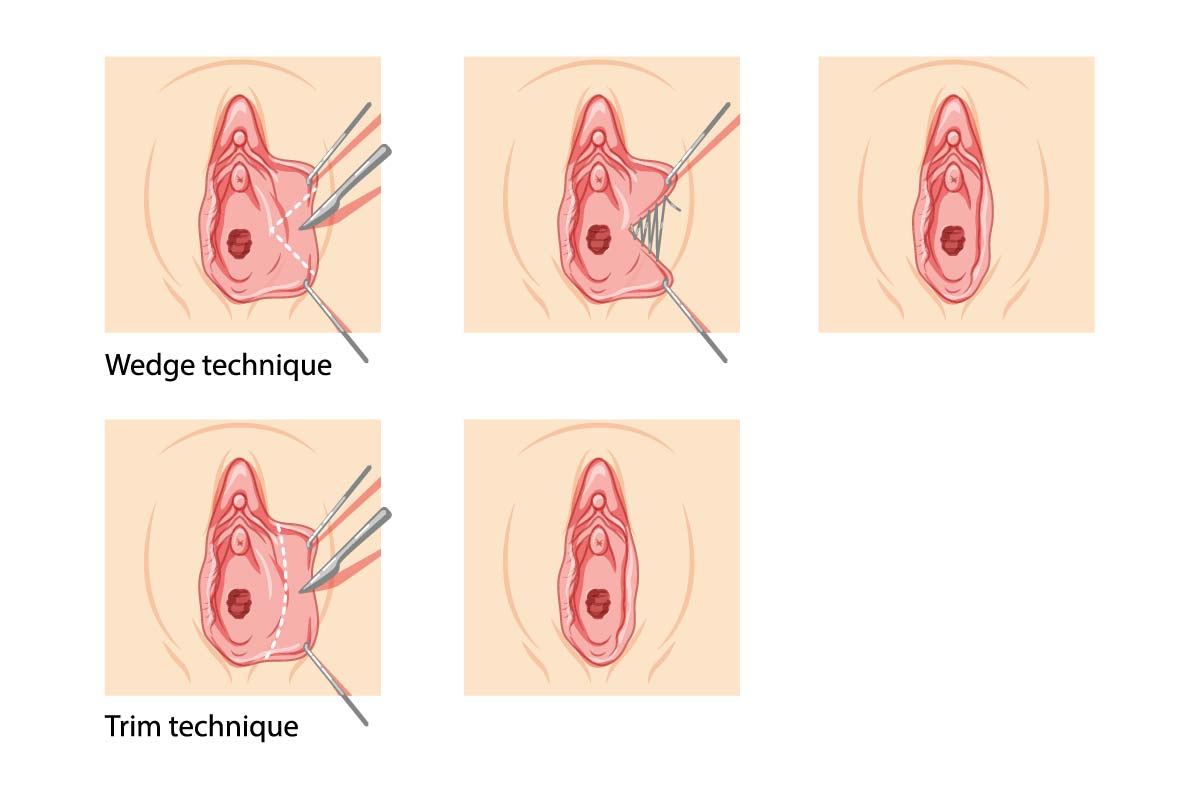
- Labiaplasty: The most common surgical option for labial hypertrophy is labiaplasty, a procedure that reshapes and reduces the size of the labia minora. It can be performed using the trim technique, where excess tissue is removed along the edge, or the wedge technique, where a V-shaped segment is excised from the centre. The aim is to achieve a smaller, more symmetrical appearance.
- Fat Grafting (Labia Majora Augmentation): For women seeking more volume in the labia majora, fat grafting is an option. During this procedure, fat is harvested from another part of the body (like the abdomen or thighs) and injected into the labia majora to restore fullness.
How Does Labiaplasty Reduce the Size of Labia Minora?
Labiaplasty is a surgical procedure that addresses the size and shape of the labia minora, making it smaller and more proportionate to the labia majora. There are two main techniques for performing labiaplasty:
- Trim Technique: This is the most common approach, where the excess edge of the labia minora is removed, creating a smoother, more uniform appearance. This technique is suitable for women with mild to moderate hypertrophy and results in a neat, natural look.
- Wedge Technique: In this approach, a wedge-shaped portion of the labia minora is excised, preserving the natural edge and reducing overall size. This method is ideal for women who wish to maintain the natural pigmentation and texture of the labia.
Both techniques can be customised based on the patient’s preferences and anatomical considerations. Recovery typically involves mild swelling and discomfort, which subsides within a few weeks. The results are long-lasting, offering both functional and aesthetic benefits.
Adding Volume to Labia Majora: What are the Options?
Aging, hormonal changes, and weight loss can cause the labia majora to lose their youthful plumpness. This can be addressed through the following methods:
- Labia Majora Fillers: Dermal fillers like hyaluronic acid can be injected into the labia majora to restore volume. This is a quick, non-surgical option with immediate results and minimal downtime. Fillers are a temporary solution, lasting around 6-12 months.
- Fat Grafting: A more permanent option involves using the patient’s own fat, harvested from areas such as the abdomen or thighs, and injecting it into the labia majora. The procedure can be done under local or general anaesthesia, depending on the extent of fat transfer required. The results are long-lasting and offer a natural feel and appearance.
- Labial Puff Surgery: For women with significant volume loss, labial puff surgery combines filler or fat transfer with minor surgical techniques to reshape and rejuvenate the labia majora. This is ideal for women looking for a more dramatic improvement.
What is Labial Puff Surgery?
Labial puff surgery is a procedure that enhances the volume of the labia majora through the injection of fillers or fat transfer, combined with skin-tightening techniques. The aim is to achieve a fuller, firmer, and more youthful look. This procedure is performed under local anaesthesia and typically involves:
- Volume Restoration: Injecting fillers or autologous fat into the labia majora to plump up the tissue.
- Skin Tightening: Minor surgical adjustments may be made to tighten loose skin, resulting in a smoother appearance.
- Reshaping: Excess skin or tissue may be trimmed to create a balanced, aesthetically pleasing result.
The recovery period is relatively short, and results are visible almost immediately. Labial puff surgery can significantly enhance the aesthetic appearance of the labia majora, helping women feel more confident and comfortable.
Final Thoughts
Understanding the anatomy of the female genitalia and the available treatment options can empower women to make informed decisions about their bodies. Labia puffing and other labial procedures, whether for aesthetic reasons or physical comfort, are personal choices that should be guided by individual needs and preferences. If you have concerns about labial volume or hypertrophy, consider booking a consultation to discuss the options that are right for you. Whether it’s labiaplasty, labia puffing, or non-surgical rejuvenation, a tailored approach can help you achieve the results you desire.
Mr Reza Nassab’s perspective
Concerns about the appearance or fullness of the labia are common and, in the vast majority of cases, entirely normal anatomy. Where there is genuine excess or asymmetry of the labia minora causing discomfort or self-consciousness, labiaplasty is a well-established surgical option. It is important to be cautious about non-surgical ‘puffing’ injectable treatments, as evidence for these is limited and they are not a substitute for proper assessment. My advice is always to start with an in-person consultation with a qualified surgeon, so any treatment is based on your individual anatomy and genuine need rather than online trends.
